
Southeast Drought Deepens Ahead of Summer, Raising Heat, Fire and Water Concerns
A dry spring replaces the Southeast’s usual stormy season
Spring across the Southeast is often associated with frequent rain, thunderstorms and bouts of severe weather. This year, the region has been facing a different headline: a drought that has expanded and intensified as the season progresses toward summer.
The shift matters not only because of day-to-day impacts on lawns, lakes and local water supplies, but because the Southeast is entering the hottest time of year with an existing moisture deficit. In practical terms, that can influence everything from how quickly vegetation dries out to how communities manage water use and how travelers plan outdoor activities.
Drought coverage is already widespread—and still growing
Across the Southeast, drought conditions are now so extensive that even incremental changes are meaningful. Regionally, areas classified as being in severe drought and extreme drought have each expanded by about 10%. That may sound modest on paper, but it is significant in a region where nearly 100% of the area is already experiencing drought.
The drought footprint spans much of the Southeast. Every part of Georgia, South Carolina, North Carolina, Virginia, Tennessee and Alabama is experiencing drought conditions. Arkansas and Florida are both at 99% in drought. Florida, in particular, is experiencing its worst drought in 25 years, according to reporting cited in the provided material.
This broad coverage means the drought is not confined to a single corridor or a handful of counties. Instead, it is affecting a wide range of landscapes—from coastal areas to inland cities and valleys—creating overlapping concerns for residents, agriculture and seasonal tourism.
Why it’s happening: a La Niña winter followed by a dry spring
The Southeast was influenced by a La Niña pattern this past winter. La Niña often favors a warmer and drier winter across the region, and that is what occurred. The dryness did not end with winter; the pattern transitioned into a dry spring, further reducing opportunities for soil and waterways to recover.
Several major cities are experiencing one of their top 10 driest spring seasons on record, according to the Southeast Regional Climate Center. The list includes Atlanta, Savannah, Tallahassee, Charleston, Charlotte, Raleigh, Richmond, Memphis, Nashville and Montgomery. When multiple population centers simultaneously see spring rainfall rank among the lowest historically, it underscores that the drought is not a localized anomaly but a regional-scale event.
This drought has been building since last fall
While conditions have deteriorated in recent weeks, the drought did not form overnight. The Southeast has been dealing with drought conditions since last fall, and the longer a drought persists, the more difficult it can be to reverse quickly.
According to drought.gov, several states experienced record dry conditions for the period from September 2025 through March 2026, with records dating back to 1895. Specifically, Georgia, North Carolina and South Carolina saw record dryness for that September–March window. The same period was the second driest for Alabama, third driest for Florida, ninth driest for Tennessee, and 10th driest for Virginia.
These rankings highlight how the precipitation shortfall spans multiple seasons. A dry fall and winter can reduce streamflow and reservoir recharge, while a dry spring can limit soil moisture recovery and stress vegetation ahead of summer heat.
Short-term rain is possible, but totals may be limited where drought is worst
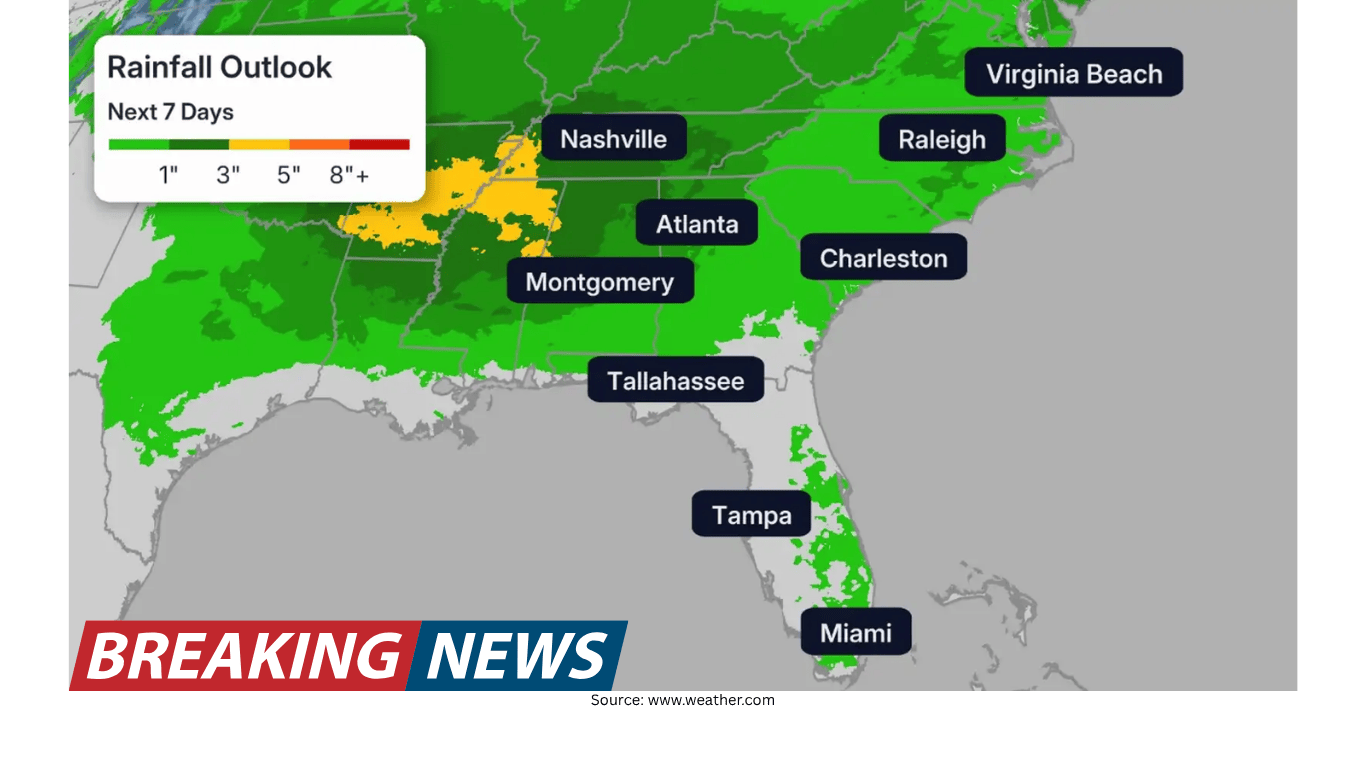
There is some near-term potential for rainfall relief. A pattern change is expected to bring at least some rain to parts of the Southeast over the next seven days. However, the forecast suggests the heaviest drought areas may not see enough precipitation to make a major dent.
In Florida and Georgia—two of the places experiencing the worst drought—rainfall may total only a half inch or less over the coming week. Parts of the Tennessee and Mississippi Valleys could see higher totals of 1 to 3 inches, which would help but is not expected to end the drought. Arkansas could see a more substantial event, as models have hinted that parts of the state may receive up to 5 inches.
Even in areas that receive a few inches, the context matters: when soils are very dry, initial rainfall can be absorbed quickly, and multiple rounds of rain are often needed to measurably improve drought categories.
Looking ahead: the drought outlook points toward worsening into summer
The longer-range outlook included in the provided information indicates that drought could worsen as the region moves into the summer months. That outlook is particularly concerning for cities such as Atlanta, Charlotte, Raleigh, Montgomery and Richmond.
Summer is already a challenging season for water balance in the Southeast. Higher temperatures increase evaporation from soil and water bodies, and plants require more moisture. When a region enters summer with depleted soil moisture and below-normal rainfall, drought impacts can intensify quickly.
How much rain would it take to erase the drought?
The scale of the deficit helps explain why a single rainy week is unlikely to solve the problem. According to NOAA, much of the Southeast would need 15 to 25 inches of rain over a three-month period to eliminate the drought completely.
That figure illustrates the difference between short-term improvement and full recovery. A few inches of rain can reduce immediate fire danger or slightly improve soil moisture, but eliminating a large, multi-season deficit typically requires sustained, above-average precipitation over time.
Heat and fire risk: why drought conditions can escalate summer hazards
One of the most immediate concerns as drought persists into summer is the potential for hotter-than-average conditions in an already hot region. Dry soils can contribute to higher temperatures because less incoming energy is used for evaporation and more is available to warm the air near the ground.
Fire danger is also expected to increase given the combination of dry fuels, hot weather and low relative humidity. Gusty winds can further worsen the situation by fanning flames and allowing fires to spread more rapidly. The provided material references wildfire impacts in Georgia, underscoring that drought is not just a statistic—it can be linked to real-world damage.
For people who plan to spend time outdoors—whether hiking, camping, or visiting parks and beaches—these conditions can change risk levels quickly. In drought-stricken landscapes, vegetation can ignite more easily, and fires can become difficult to control, especially when winds increase.
Travel and vacation planning: what to consider in drought-stricken areas
Summer travel is a major part of life in the Southeast, and drought can affect vacations in several ways. The most serious concern is wildfire risk. Travelers who are not familiar with wildfires are urged in the provided information to have a plan in place in case an evacuation becomes necessary.
Beyond wildfire concerns, drought can also affect the overall experience of a destination. Dry conditions can influence air quality during fire events, limit certain outdoor activities, and contribute to restrictions on water use. While the specific rules vary by location, the broader point is that drought can shape what visitors can do and what precautions they should take.
- Monitor local conditions if traveling in drought-affected areas, especially where fires are active or where fire danger is elevated.
- Be prepared to adjust plans if conditions change, including the possibility of evacuation orders in wildfire situations.
- Expect that some communities may implement water restrictions during prolonged dry periods.
Soil moisture is low, with ripple effects for agriculture
Soil moisture across the Southeast is very low, according to the provided material. That matters because soil moisture is a key buffer during dry stretches. When soils are depleted, plants and crops have less stored water to draw on, and the landscape can dry out faster between rain events.
Low soil moisture can affect the agriculture industry in multiple ways, from increased irrigation needs to heightened stress on crops and pasture. While the provided information does not quantify agricultural losses, it does emphasize that low soil moisture is an ongoing concern for the sector.
Water restrictions and low water levels: pressure on supplies
As drought persists, water levels can drop, prompting communities to manage supplies more carefully. The provided information notes that low water levels have led to some water restrictions, particularly in parts of Florida, as reported by drought.gov.
Restrictions are one of the more visible signs of drought for residents and visitors. They can include limits on outdoor watering and other conservation measures intended to stretch available supplies. The presence of restrictions also signals that the drought is affecting not only the landscape but also the systems communities rely on.
What to watch next
The Southeast’s drought story is now a combination of what has already happened—months of unusually low precipitation—and what comes next: whether rain events become frequent enough to slow or reverse the trend. The near-term forecast offers some rain, but the expected totals in the hardest-hit areas may be limited. Meanwhile, the outlook suggests drought could worsen into summer, raising concerns about heat, fire danger, low soil moisture and continued strain on water resources.
With nearly the entire region experiencing drought conditions, the impacts are likely to be felt across daily life and seasonal plans. The key variables in the weeks ahead will be rainfall coverage and persistence, and whether meaningful relief arrives before summer heat peaks.